Strategic Portfolio Management (SPM) is moving beyond project tracking to become the way enterprises connect strategy, investment, and execution. That is the central theme of the SPARK Matrix: Strategic Portfolio Management Solutions, 2026, published by QKS Group (Quadrant Knowledge Solutions), a global advisory and consulting firm. Below are the five key findings from the report and what they mean for portfolio leaders.
What is Strategic Portfolio Management?
Strategic Portfolio Management is a discipline and category of software that aligns an organization’s investments with its strategic objectives. An SPM platform brings strategic planning, investment governance, financial management, resource capacity, and outcome tracking into one environment, so leaders can decide what to fund, what to pause, and how to allocate people and budget across the whole portfolio.
Key findings from the 2026 SPARK Matrix
- Why is enterprise demand for Strategic Portfolio Management growing?
Demand is growing because organizations need clearer visibility into how their investments contribute to strategic objectives. Traditional project management tools do not provide enough insight into funding decisions, resource allocation, and business outcomes across complex transformation portfolios. Enterprises managing digital transformation, AI adoption, regulatory initiatives, and product modernization need a unified platform that connects strategy, execution, financial planning, and governance. As portfolios become more complex, buyers are prioritizing SPM solutions that support continuous decision-making, investment optimization, and measurable business value rather than simply tracking project delivery.
- How is Strategic Portfolio Management different from Project Portfolio Management?
Project Portfolio Management (PPM) focuses mainly on project execution, while SPM is a strategic decision-making platform. According to QKS, many organizations still associate SPM primarily with traditional PPM and evaluate solutions mostly on execution capabilities, overlooking broader strategic functions. Mature buyers, by contrast, see SPM as integrating planning, investment governance, financial management, resource capacity, and outcome tracking. As transformation initiatives become more business-driven, awareness is shifting toward SPM as a critical enterprise capability for aligning strategy, investments, and execution.
- Why are organizations replacing fragmented planning tools with SPM?
Organizations are adopting SPM to replace disconnected planning processes with a single, unified approach to strategy execution. Instead of managing projects, budgets, resources, and roadmaps across separate tools, enterprises want one platform that aligns investments with strategic priorities. The capabilities end users value most include investment prioritization, scenario planning, capacity management, financial governance, and benefits realization. Being able to quickly reassess priorities, rebalance funding, and optimize resources helps organizations respond to changing business conditions and improves executive decision-making and portfolio performance.
- How is the Strategic Portfolio Management market changing?
The SPM market is evolving quickly as vendors from adjacent segments expand into the category. Traditional PPM providers are strengthening strategy execution and investment governance, while enterprise architecture, agile planning, and work management vendors are increasingly positioning their platforms as SPM. This convergence reflects customer demand for integrated strategy-to-execution platforms rather than standalone portfolio tools. Buyers are now evaluating vendors on how well they connect strategic planning, financial governance, enterprise architecture, product delivery, and resource management in one decision-making environment.
- What role does AI play in Strategic Portfolio Management?
AI is becoming an important differentiator in SPM by improving portfolio intelligence, not by replacing human decision-making. Organizations are gaining value from AI-assisted investment prioritization, scenario analysis, resource optimization, risk identification, executive reporting, and portfolio summarization, which reduce manual analysis and speed up data-driven decisions. QKS notes that AI delivers the most value when it is supported by high-quality portfolio data and well-defined governance processes. Executive judgment remains central to strategic decisions, positioning AI as decision support rather than autonomous portfolio management.
What is the SPARK Matrix?
The SPARK Matrix is a vendor evaluation framework from QKS Group. Each report covers one technology category, such as ITSM, SOAR, or enterprise agile planning, and rates vendors on two dimensions: technology excellence and customer impact. The framework helps buyers compare vendors side by side and determine the best fit for their requirements and budget.
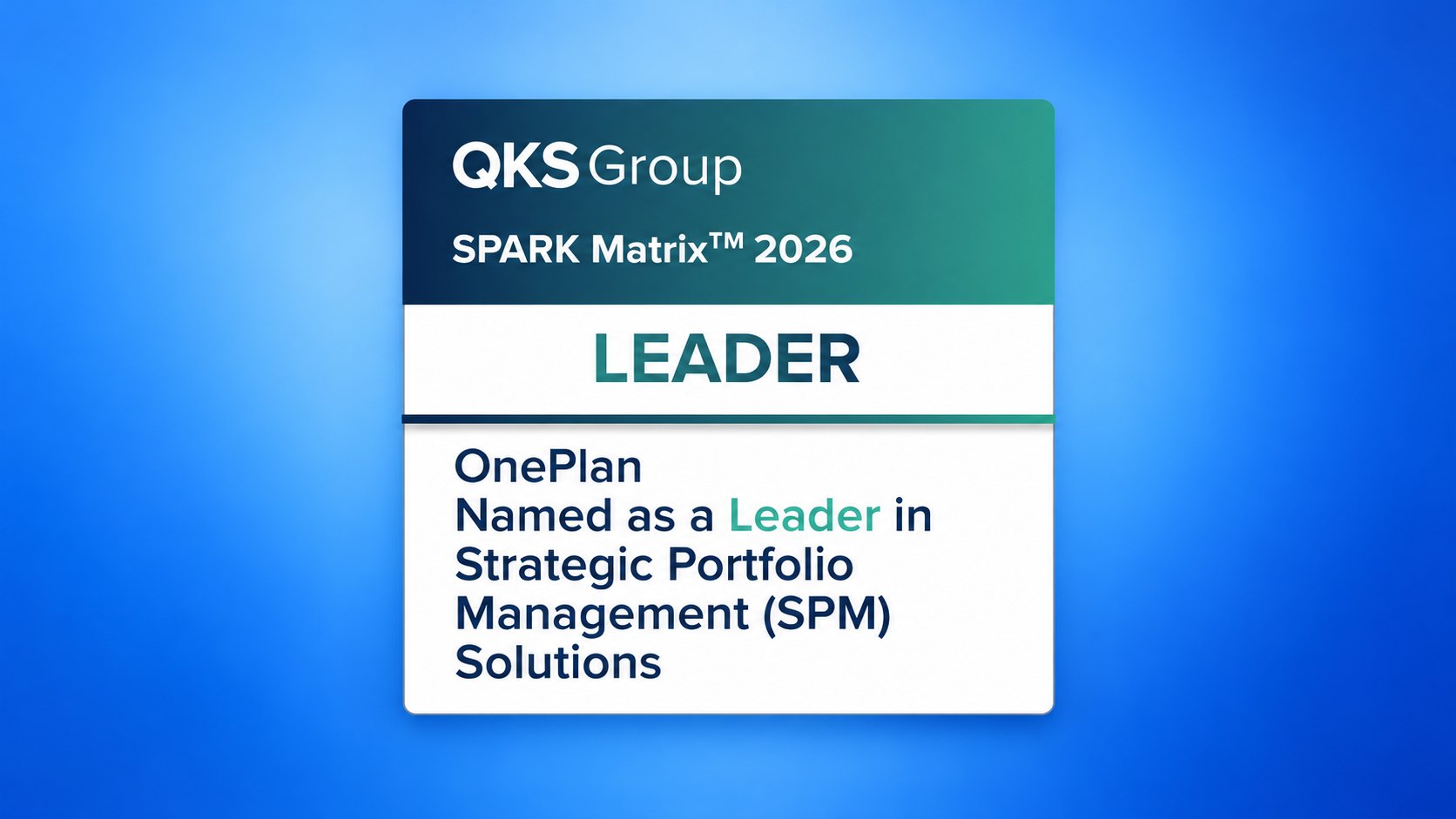
OnePlan named a Leader in the 2026 SPARK Matrix for Strategic Portfolio Management
QKS Group positioned OnePlan as a Leader in the SPARK Matrix: Strategic Portfolio Management Solutions, 2026. The evaluation assessed OnePlan across investment prioritization, resource and financial planning, governance, hybrid delivery support, and AI-assisted decision-making, and identified both strengths and areas to watch.
Strengths highlighted in the report include:
Microsoft-native architecture: OnePlan is delivered through the Microsoft Cloud and connects directly with Teams, Power BI, Azure DevOps, Planner, Microsoft Project, Power Platform, Dataverse, and Entra ID, providing a planning layer that fits existing Microsoft environments.
Portfolio Modeler: Teams can test investment scenarios across budgets, timelines, resources, and strategic priorities before decisions are made, with capacity, funding, and delivery impact shown in the same view.
Configurable governance: Intake, business cases, scoring, approvals, stage gates, and workflow rules can be structured to match how an organization governs work, without requiring every team to follow the same delivery process.
Sofia AI: OnePlan’s embedded AI summarizes status, surfaces risks, and assembles update material, reducing the preparation required for portfolio reviews.
Hybrid portfolio management: Traditional projects, Agile, Scrum, Kanban, SAFe, product work, and operational streams can feed into a common portfolio view without changing how delivery teams work.
Who is OnePlan best suited for?
OnePlan is best suited to mid-sized and large enterprises that need structured portfolio governance rather than basic task tracking or standalone reporting, particularly organizations managing multiple portfolios, mixed delivery methods, and distributed teams where leadership needs better visibility into prioritization, capacity, funding, and delivery performance.