Most AI conversations in project and portfolio management are about productivity: faster status reports, meeting summaries, risk analysis, and executive briefings. Useful, but incremental.
The real shift comes when AI stops assisting the PMO and starts participating in its work: planning, coordinating, governing, and executing. Thomas Kuhn called this kind of change a paradigm shift, the point where we stop improving a model and start questioning its assumptions. Better carriages improved transportation. The automobile replaced the model. Agentic AI is the automobile, not a faster horse, and it changes what PMO leaders need from their systems.
What is agentic AI for PMOs?
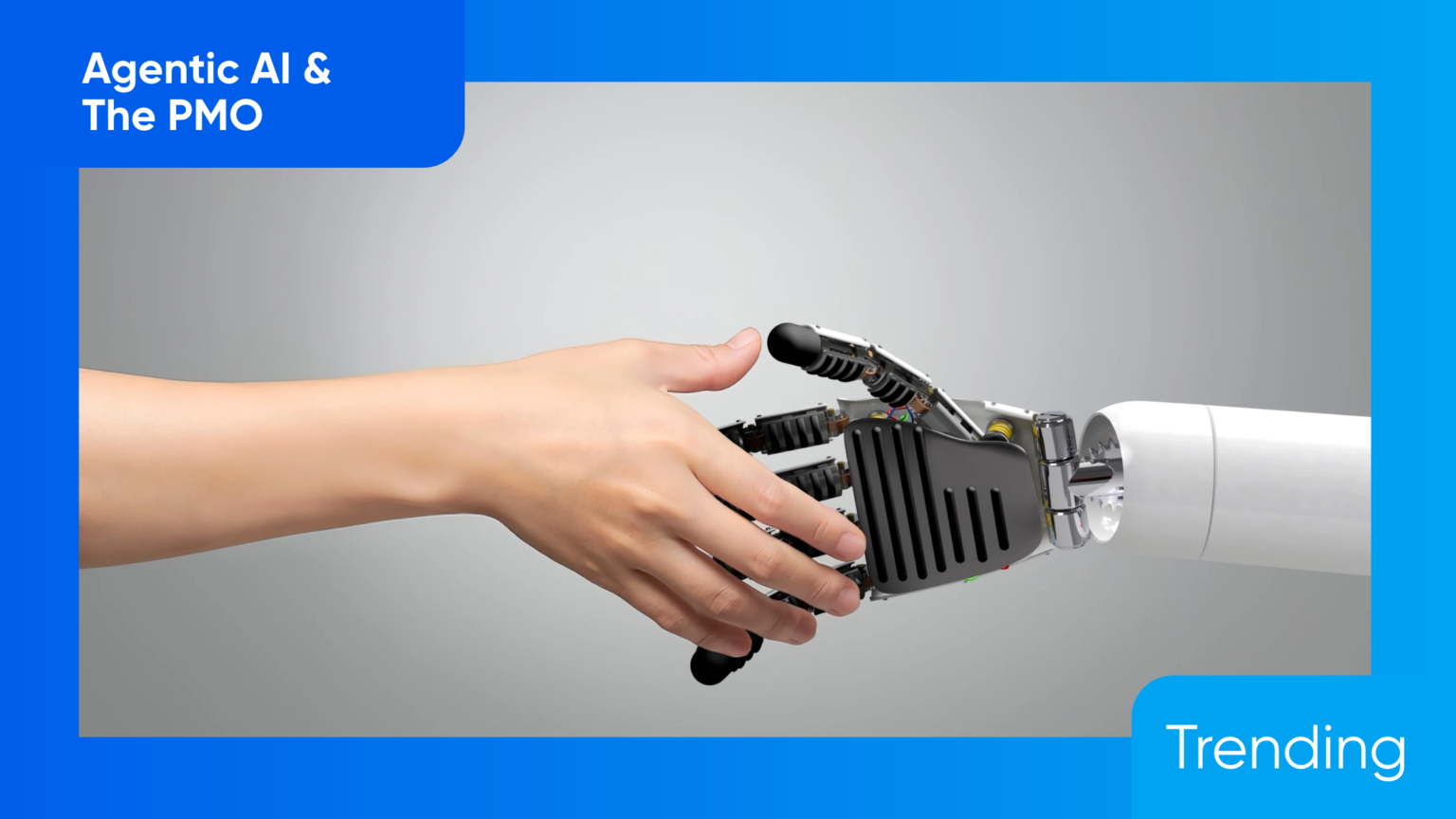
Agentic AI for PMOs refers to AI agents that pursue portfolio objectives on their own. They monitor schedules, capacity, costs, and risks across tools, diagnose emerging issues, and prepare or execute actions within governance limits the PMO defines. Unlike generative AI, which assists people with tasks, agentic AI participates in the work itself.
In practice, an agentic PMO is one where people and AI agents share the work of portfolio management. Agents handle continuous monitoring, data consolidation, and first-pass analysis. People own strategy, investment decisions, and governance.
Agentic AI vs. generative AI vs. copilots: what’s the difference?
The terms are often used interchangeably, but they describe different levels of autonomy:
| Generative AI | Copilots | Agentic AI | |
|---|---|---|---|
| What it does | Creates content on request | Assists a person inside an application | Pursues an objective across applications |
| Who drives | The person | The person | The agent, within defined limits |
| Typical PMO use | Drafting a status report | Summarizing a project in Teams or Project | Monitoring the portfolio and flagging a capacity conflict before it hits |
| Scope | One prompt, one output | One app, one user | Multiple tools, multi-step tasks |
| Governance need | Content review | User judgment | Explicit decision rights and approvals |
How does agentic AI change who does the work?
For decades, enterprise software rested on one assumption: people do the work by using applications. Generative AI loosened that by letting people state intent (“Why is this program slipping?”) instead of clicking through every step. But the person still drove.
Agentic AI changes who does the work. Agents from OpenAI, Anthropic, Microsoft, and others can take an objective, gather what they need, use tools across applications, monitor conditions, and act within defined limits.
Person → Application → Data
Person → Objective → Agent → Applications and Data → Action
Applications stop being destinations people navigate and become capabilities agents call on. Their role as systems of record does not shrink. It grows, because an agent is only as good as the data and rules it draws on.
Why haven’t most organizations seen enterprise value from AI yet?
Many organizations see individual productivity gains from AI, but few see enterprise-level financial impact. The usual cause is that AI gets added to existing processes without changing the decisions, handoffs, and structures around them. The better question is: “How should we design this process if people and AI agents can both do the work?”
That is an operating-model question, not a technology question. Organizations built as Person → Role → Process → Application begin to organize as Outcome → Capability → Work → Human + Agent → Tools. That changes how leaders think about capacity, accountability, and decision rights, and it lands squarely on the PMO.
How does agentic AI change the role of the PMO?
The biggest mistake a PMO leader can make is to treat agentic AI as a better reporting tool.
Today’s reporting cycle is periodic and manual. Project managers update status, analysts consolidate it, dashboards go to executives, someone spots a problem, teams investigate, and recommendations arrive weeks later.
Agents make a continuous model possible. They can watch schedules, dependencies, capacity, financial variance, risks, and benefit forecasts; flag issues as they emerge; diagnose likely causes; and have options ready before the next portfolio review.
Example: a slipping program, before and after
Today: A critical integration team tracked in Jira falls three sprints behind. The program schedule in Microsoft Project doesn’t reflect it until the PM updates status at month-end. The PMO consolidates reports the following week, and the slip surfaces at the quarterly portfolio review. By then, two dependent projects have already committed resources they can’t use.
With an agent: The agent monitors Jira velocity and the program’s dependency map continuously. Within days of the slip, it flags the downstream impact on the two dependent projects, estimates the cost of idle capacity, and prepares three options: re-sequence the dependent work, shift two engineers from a lower-priority initiative, or rebaseline the program. The PMO lead reviews the options and approves one the same week.
The executive question shifts from “What happened to our projects?” to “Which action gets us to our outcomes?”
The PMO moves up, not out
The PMO does not disappear. Status consolidation, routine reporting, meeting prep, and first-pass analysis increasingly move to agents. That frees the PMO to focus on investment decisions, strategic alignment, capacity planning, benefits realization, and risk governance.
The PMO evolves from a reporting and control function into an enterprise portfolio intelligence and orchestration function.
What governance do AI agents need in a PMO?
AI that acts carries more risk than AI that writes. As decisions extend from people to agents, governance matters more, not less. PMOs need explicit AI decision rights: a clear definition of what an agent may do on its own and what requires human approval. We call this the AI decision rights ladder:
| Level | What the agent may do | Example PMO actions | Approval |
|---|---|---|---|
| 1. Observe | Monitor data and detect conditions | Track schedule variance, capacity, budget burn | None |
| 2. Recommend | Diagnose issues and propose options | Suggest re-sequencing, flag benefit risk | None; human decides |
| 3. Prepare | Draft the action, ready to execute | Stage a resource reallocation or forecast change | Human approves before execution |
| 4. Execute | Take the action within set thresholds | Adjust a schedule within tolerance, escalate a risk, update a forecast | Pre-approved by policy; logged and auditable |
Each PMO should decide, action by action, where each type of decision sits on the ladder. For example, may an agent reallocate a resource, change a forecast, or shift investment? Up to what threshold, and with whose approval? Most PMOs should start agents at Levels 1 and 2 and move specific, low-risk actions up the ladder as trust builds.
What makes a PMO agent-ready?
An agent can only reason about a portfolio as well as that portfolio is modeled. If strategy lives in slides, budgets in spreadsheets, capacity in someone’s head, and work in five different tools, agents will simply automate the confusion.
Whatever platform you use, an agent-ready PMO needs a system of record that meets four criteria:
- One data model from strategy to execution. Objectives, investments, plans, resources, costs, risks, dependencies, and benefits are connected, so agents can trace any issue to its business impact.
- Work pulled in from wherever teams do it. Agents see the whole portfolio, not one tool’s slice.
- Governance encoded in the system. Stage gates, approvals, and decision rights apply to people and agents alike.
- Open, governed access for agents. Agents connect directly to portfolio data, for example through the Model Context Protocol (MCP), an open standard that lets AI agents securely query and act on data in business applications. Without it, agents work from exports and stale snapshots.
Moving off Project Online? Choose an AI foundation, not just a replacement
Microsoft Project Online retired on September 30, 2026. For PMOs still migrating, the new platform will be more than a scheduling tool. It will be the data foundation every AI agent in the portfolio depends on. Evaluate replacements against the agent-ready criteria above, not just feature parity with Project Online.
How OnePlan supports the agentic PMO
OnePlan was built as the system of record for this model:
- One platform, one data model. Strategy, portfolio, financial, resource, and work management are connected for people and agents alike.
- One front door for ideas. The Innovation Portal captures and prioritizes requests against strategy and capacity, with [Sofia AI] helping refine submissions so the portfolio starts with decision-ready data.
- A dedicated AI portfolio. Manage AI initiatives with their own intake criteria, costs, risks, and benefit targets, alongside every other investment.
- Every team’s work in one view. OneConnect brings in work from Microsoft Project, Planner, Azure DevOps, Jira, Smartsheet, monday.com, Asana, and more.
- Native to Microsoft 365 and Copilot. OnePlan runs inside Teams, SharePoint, and Power BI, and organizations can extend Sofia with their own Copilot agents.
- Governance built in. Approvals and no-code automations give the PMO one place to define and enforce decision rights.
PMOs can start learning with agents in weeks, not quarters.
What PMO leaders should do now
- Find the work agents should take first: tasks that are repetitive, coordination-heavy, or depend on gathering data from multiple sources.
- Map decision rights: place each candidate action on the decision rights ladder, from observe to execute.
- Fix the portfolio data model: connect strategy, investments, work, resources, costs, risks, dependencies, and benefits in one system of record.
- Start with focused use cases: portfolio briefings, schedule-risk analysis, capacity conflicts, benefit tracking, and executive decision support.
- Change the scorecard: measure decision speed and quality, resource use, risk reduction, alignment, and realized benefits, not report volume or template compliance.
Frequently asked questions
What is an agentic PMO?
An agentic PMO is a project management office where AI agents and people share the work of portfolio management. Agents continuously monitor and analyze portfolio data and prepare actions, while people own strategy, investment decisions, and governance.
Will AI agents replace PMO staff?
No. Agents take over routine work such as status consolidation, reporting, and first-pass analysis. That shifts PMO staff toward higher-value work: investment decisions, strategic alignment, capacity planning, and benefits realization.
What should AI agents be allowed to do without approval?
That depends on the PMO’s risk tolerance. Most organizations start by allowing agents to observe and recommend without approval, then pre-approve specific low-risk actions, such as escalating a risk or adjusting a schedule within tolerance, as trust builds.
How do AI agents access portfolio data?
The most robust approach is direct, governed access through standards like the Model Context Protocol (MCP). This lets agents query and act on live portfolio data under the same permissions and rules as people, rather than working from exports.
What is the difference between agentic AI and generative AI in project management?
Generative AI creates content when asked, such as drafting a status report. Agentic AI pursues an objective across tools and takes multi-step actions, such as detecting a capacity conflict, diagnosing the cause, and preparing a resolution for approval.
Is Microsoft Project Online being retired?
Yes. Microsoft Project Online retired on September 30, 2026. Organizations still using it need to migrate to a new platform for project and portfolio management.
The bigger opportunity
The real shift is not that AI gets smarter. It is that organizations redesign work around the fact that people are no longer the only actors who can analyze, coordinate, and execute.
PMO leaders face a choice: use AI to make today’s PMO slightly faster, or use it to redefine the PMO’s value. The future PMO won’t collect information and report what happened. It will continuously connect strategy, investment, execution, decisions, and outcomes, and govern how people and AI agents work together across that system.
That starts with the system of record. See how OnePlan gives people and AI agents one governed view from strategy to execution here.